
Atrial fibrillation is the commonest heart rhythm disturbance and heart failure is the commonest abnormality of the heart muscle. When they co-exist, patients experience more severe symptoms and their survival can be impacted adversely. We work closely with clinical electrophysiologists to develop a better understanding of the reasons that cause the heart to fail more aggressively when the two conditions coexist.
We apply a range of complementary techniques in isolated cells, tissues, blood samples and in patients. In isolated heart cells we have demonstrated that an irregular heart rhythm causes major changes in the expression of genes and proteins related to heart contraction. In support, we have demonstrated in patients with AF and HF, a reduction in the heart's pumping capacity.
Our future studies aim to evaluate the way in which the heart's metabolism changes when the rhythm is restored to a regular pattern (sinus rhythm) from an irregular one.
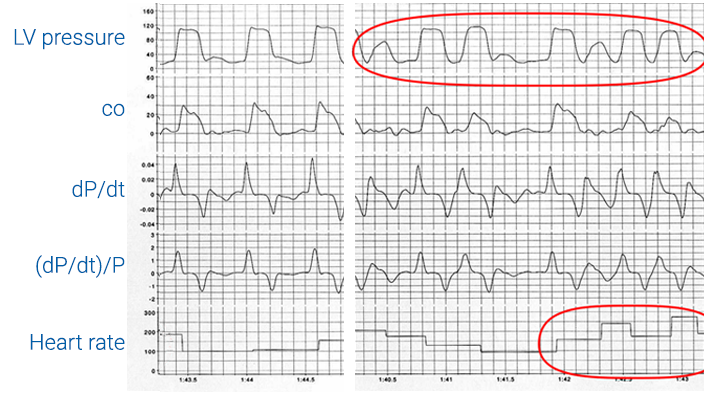
Pressure trace of the left ventricle in normal rhythm vs irregular rhythm, indicating reduced pump function and increased heart rate.