
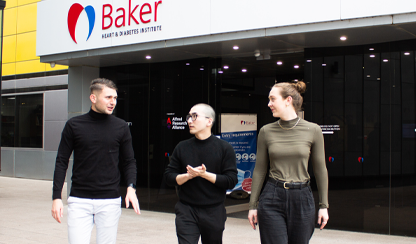
The Baker Institute is incredibly proud of the calibre of students that join us in the fight against heart disease and diabetes. Your support allows us to create a collaborative, stimulating and supportive environment for students to develop the skills and the confidence to launch their careers in medical research. Meet our Student Committee co-presidents, Crisdion Krstevski and Terence Fong, and vice president, Yvette Schooneveldt, who gave us a look into the world of student researchers.
What led you to a career in medical science?
C: I have always been passionate about science and helping people and was lucky enough to have brilliant mentors in high school who guided me into pursuing a scientific career. I joined the Baker Institute in 2018 doing voluntary placement hours. I am now in the 3rd year of my PhD investigating the cellular and molecular mediators of heart thickening.
T: Science has always been one of my biggest passions, and my interest in the early stages of prevention for heart disease was cultivated in my Honours year at university. I am currently in the 2nd year of my PhD investigating vascular ageing in youth.
Y: In the final year of my undergraduate degree, I spent 6 months working in a laboratory on a ‘mini Honours project’. I fell in love with research quickly from there. Fast forward to today, I am in the 2nd year of my PhD studying lipid metabolism, which involves the breakdown and processing of small fat molecules in disease settings.
What does the Baker Institute Student Committee do?
Y: Throughout the year we aim to provide opportunities for students to connect in both academic and social forums, with the hope of fostering meaningful relationships. Being a student can be an incredibly stressful and overwhelming time so we hope to encourage students to lean on each other throughout the year, whilst bettering their skills as future academics.
What is one of the best things about working at the Baker Institute?
C: The Baker Institute provides a highly collaborative working environment, both internally and externally. This is something that I have benefited from personally, as colleagues have introduced me to new techniques and offered novel insights that I have been able to incorporate into my own work. Working here also gives us access to advanced technology that is not easily accessible in a university setting. This allows us to learn, to challenge fundamental scientific questions and to make discoveries. What would you say to encourage young researchers who may be considering studying and investing time in heart disease and diabetes research?
T: Some practical tips: Speak with researchers, visit laboratories, take university subjects that offer a practical experience component, volunteer, and allow yourself to be curious. Research is incredibly exciting and really rewarding, and with the current rates of heart disease and diabetes continuing to rise, we can never have too many researchers in this critical field!
If you know someone who would like to pursue a career in medical research, get them to check out our website for more information.