

Project leader: Professor Mark Febbraio
Exercise provides powerful protection against chronic diseases, but the molecular mechanisms behind these benefits have remained largely mysterious. In 2018 (Whitham et al.), we made a breakthrough discovery: organ-to-organ communication during exercise is largely mediated by extracellular vesicles (EVs) — tiny packages released by cells that carry biological messages throughout the body (see figure below).
Since then, we've performed extensive preclinical experiments demonstrating that exercise-derived EVs are a key mechanism by which exercise confers benefit in type 2 diabetes (T2D), metabolic dysfunction-associated steatohepatitis (MASH) and breast cancer.
Our approach
We collect blood from mice immediately after acute exercise, with samples from sedentary mice serving as controls. EVs are isolated using size exclusion chromatography, separating EV-rich fractions from EV-poor fractions. These purified fractions are then either applied to cells in vitro or adoptively transferred via tail injection into mouse models of disease.
This approach has revealed that EVs released during exercise carry therapeutic cargo capable of replicating exercise's beneficial effects — even in recipients that haven't exercised themselves.
What we've found
Our studies across three major disease areas have shown that exercise-derived EVs can:
- Type 2 diabetes: improve glucose metabolism and insulin sensitivity.
- MASH: reduce liver inflammation and fat accumulation.
- Breast cancer: slow tumour growth and improve treatment outcomes.
Moving toward clinical application
We're now advancing this research program in both preclinical and clinical experiments, working to determine whether exercise-derived EVs could be developed as novel therapeutics — offering the benefits of exercise to patients who are unable to exercise due to disability, illness or frailty.
This research opens the possibility of creating 'exercise in a bottle' — a therapeutic approach that could transform treatment for millions of people living with chronic diseases.
Figure
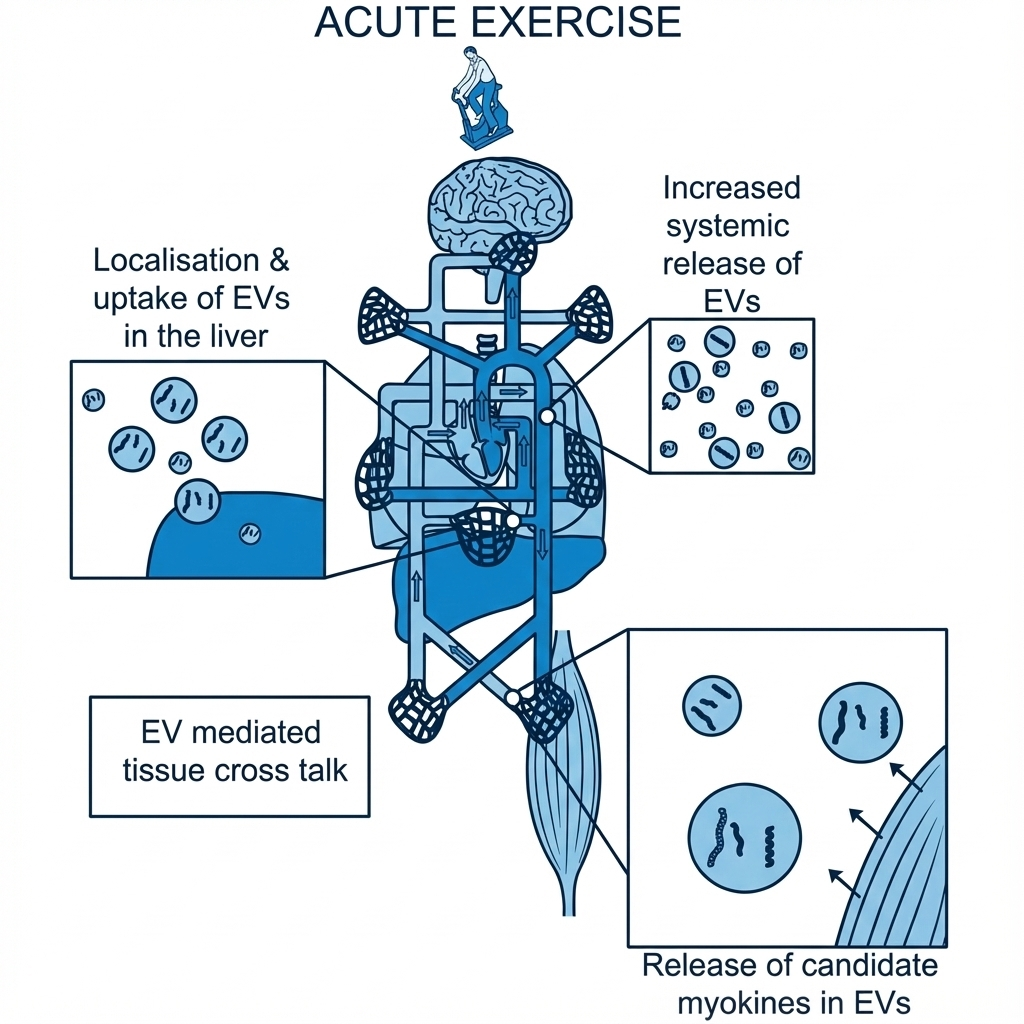
Figure: Small vesicles are released into the circulation with exercise, and participate in tissue cross-talk to prevent disease progression (Whitham et al. 2018).